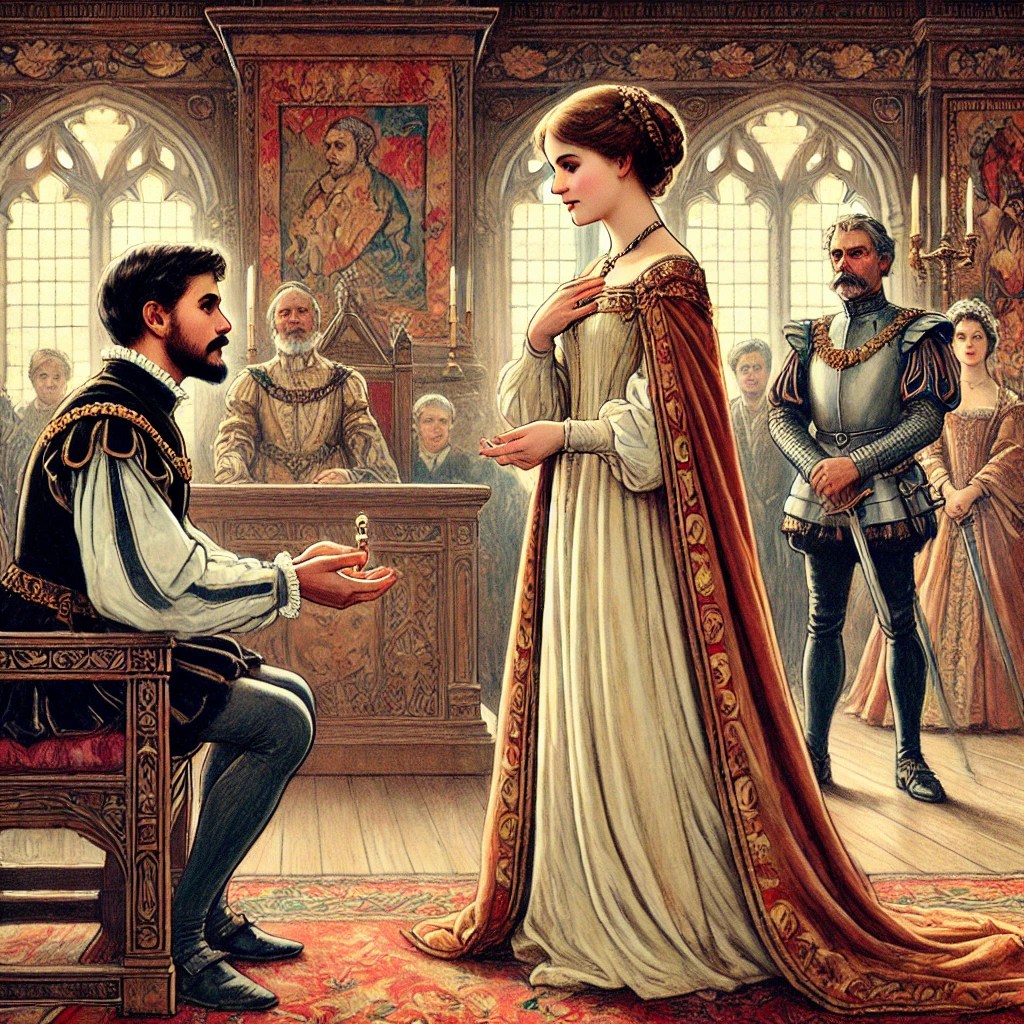
Often labeled a problem comedy, William Shakespeare’s All’s Well That Ends Well weaves together strands of love, deception, and redemption to explore the tension between natural and spiritual interpretations of the world. The playgoer should leave the theater considering the role of divine providence in human affairs, and because it’s a comedy, the audience member’s focus should be on the way providence brings about a happy ending.
The play follows Helena, a lowborn physician’s daughter, who is in love with Bertram, the son of a countess. When Helena cures the King of France of a seemingly incurable illness thanks to one of her dead father’s remedies, she is rewarded with the right to choose any husband in the kingdom. She selects Bertram, who reluctantly marries her but immediately flees to war in Italy, vowing never to accept Helena as his wife unless she can obtain his family ring and bear his child. Through cunning and determination, Helena follows Bertram to Italy and, with the help of a bed trick involving Diana–a woman Bertram is pursuing–fulfills his impossible conditions. The play’s subplots involve the exposure of Bertram’s cowardly servant Parolles. As the play ends, Bertram recognizes Helena’s worth and the pair are happily reunited.
Helena’s “bed trick” bears a striking resemblance to the biblical story of Judah and Tamar. This parallel is not coincidental; rather, it serves as a reminder that God often works in mysterious ways, using seemingly questionable means to achieve His ends. Just as Tamar’s deception ultimately preserved the lineage of Judah (and, by extension, Christ), the bed trick in All’s Well becomes a catalyst for redemption and reconciliation.
Shakespeare represents different moral positions in his play’s characters. On one end of the spectrum, we have Parolles, the quintessential reprobate—a liar, cheat, and sycophant with no redeeming qualities. On the other, we find saintly women like Helena and the Countess of Rousillon, Bertram’s mother, who both embody virtue and wisdom.
Between these extremes lie characters like the King and Bertram, who stand at moral crossroads. The King, initially fearful of death and change despite his dire condition, finds redemption through Helena’s miraculous cure. Bertram, influenced by the corrupting presence of Parolles, struggles with his own nature before ultimately recognizing his fallen state and embracing redemption.
The character of Lafeu serves as a moral compass, delivering what might be considered the play’s key speech:
They say miracles are past
And we have our philosophical persons
To make modern and familiar
Things supernatural and causeless.
Hence is it that we make trifles out of terrors
Ensconcing ourselves into seeming knowledge
When we should submit ourselves to an unknown fear.
This speech encapsulates a central theme of the play: the danger of reducing supernatural events to mere material causes. In the context of Helena’s medical cure of the King, Lafeu suggests that we should see God’s providence at work rather than attempting to explain away the miraculous.
The play’s title takes on a deeper meaning when viewed through this lens of divine providence. It echoes the concept of the “fortunate fall” in Christian theology, where even humanity’s sins can be part of God’s greater plan for redemption. As the saying goes, “God works in mysterious ways his wonders to perform.”
Shakespeare’s use of biblical typology and his exploration of providence invite us to consider the play as an example of “God drawing straight with crooked lines.” Just as God used women throughout the lineage of Judah and David to fulfill His will, the play shows how Helena’s seemingly questionable actions ultimately lead to redemption and reconciliation.
Shakespeare challenges his audience to look beyond surface-level interpretations and consider the possibility of a higher purpose at work in the world. By doing so, he transforms a potentially problematic plot into a powerful allegory of redemption, reminding us that in life, as in art, all may indeed be well that ends well.
 Experiments in Criticism