Shakespeare’s Measure for Measure is the third in his series of problem plays, following Troilus and Cressida and All’s Well That Ends Well (which I wrote about here). Written at the turn of the 17th century, MFM is steeped in Christian themes and allusions, most notably in its title, which references Matthew 7:2: “For in the same way you judge others, you will be judged, and with the measure you use, it will be measured to you.”
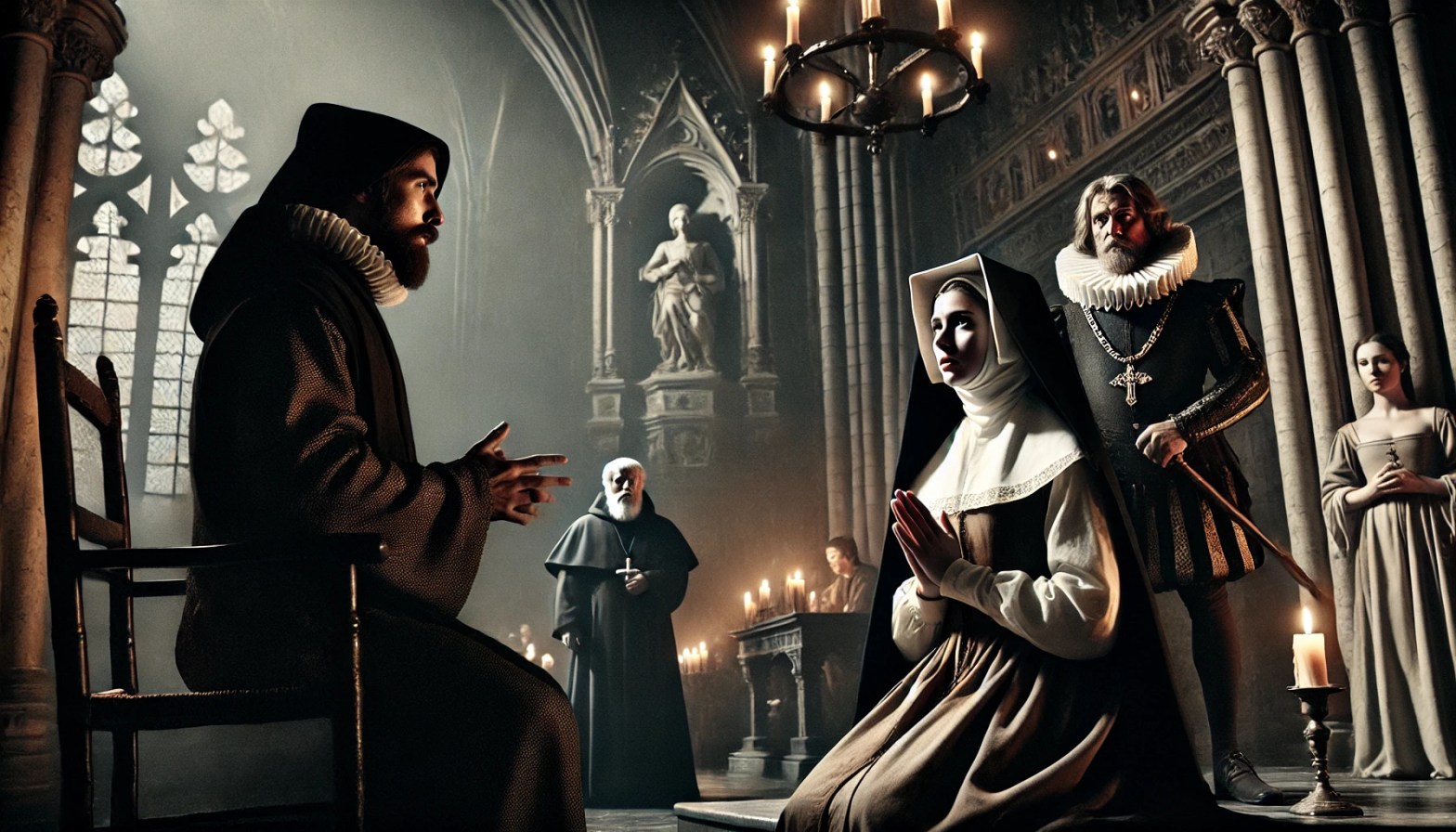
Set in Vienna, the play focuses on a Duke who feigns abdication and then disguises himself as a friar to observe his deputy Angelo’s rule. Angelo, known for his strict morality, sentences Claudio to death for premarital sex. Claudio’s sister Isabella, a novice nun, pleads for her brother’s life. Angelo offers to spare Claudio if Isabella sleeps with him. The Duke orchestrates a bed-trick, substituting Angelo’s jilted fiancée Mariana for Isabella. Eventually, the Duke reveals himself, exposing Angelo’s hypocrisy. The play ends with Angelo marrying Mariana, Claudio marrying his pregnant fiancee, and the Duke proposing to and being accepted by Isabella.
While the play concludes without any deaths, the resolution feels unsettling compared to All’s Well. In that play, Helena engineers the bed-trick. In MFM, the Duke orchestrates the entire scenario. This puppet-master approach is reminiscent of the friar’s work in Romeo and Juliet (we all know how that turned out!) and leaves characters like Isabella in the dark about crucial information. If we’re drawing Old Testament parallels, the Duke’s actions in MFM more closely resemble Laban’s deception of Jacob than Tamar’s righteous trickery of Judah.
The Duke’s character is complex and problematic. He’s portrayed as melodramatic, more of a playwright and director than a ruler or holy man. His initial failure to enforce laws led to the situation he now seeks to rectify through elaborate schemes.
Theologically, the play grapples with the concepts of grace and mercy. Grace, defined as unmerited favor, contrasts with mercy, a gift where one fails to receive deserved punishment. These concepts tie into two of the Bible’s central questions: how can God’s justice be reconciled with His mercy, and how can a good God have created a world filled with evil?
The Duke positions himself as something like a god, while his deputy Angelo represents a fallen angel. However, this analogy raises disturbing implications. The Duke’s attempts to mimic God’s providence through human machinations come across as mere meddling, both politically reprehensible and ecclesiastically questionable. The absence of any moral voice from the church amidst the rampant sexual crimes in Vienna is additionally troubling.
Jesus’ challenging words from the Sermon on the Mount echo through the play: “Unless your righteousness exceeds that of the Pharisees, you will not inherit the kingdom of heaven.” This statement underscores the impossibility of earning salvation through works alone, as we all deserve punishment for our sins.
MFM presents a disconcerting picture of human-manufactured grace and mercy. It seems to advocate for increased sin to amplify the need for grace, which is a problem, to say the least.
 Experiments in Criticism