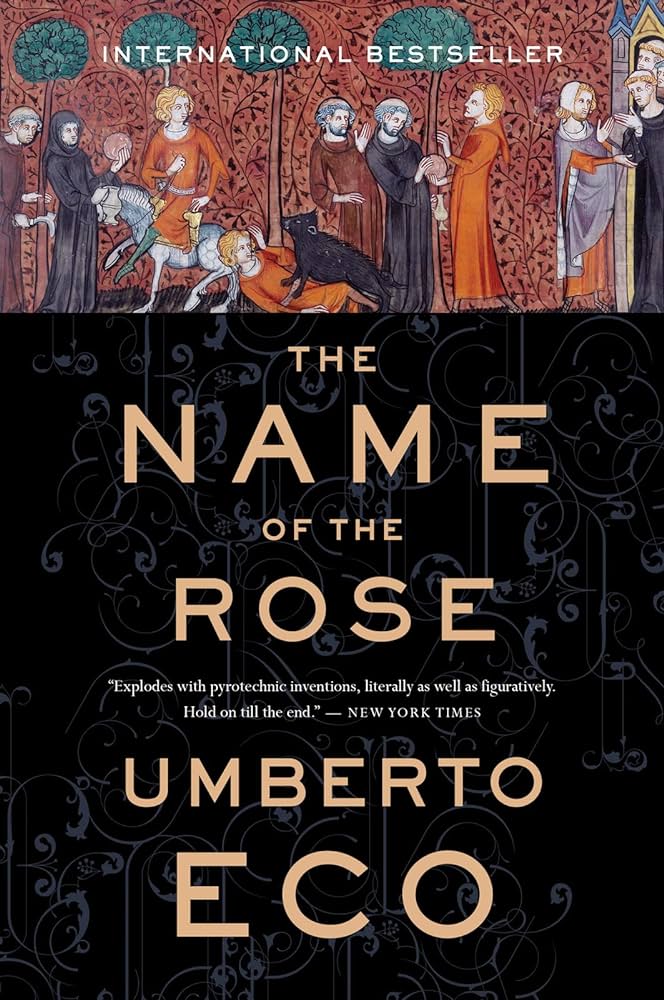
Umberto Eco’s The Name of the Rose is a literary phenomenon with a mysterious cultural appeal. How did this philosophically dense, 500+ page novel about medieval monks sell fifty million copies? We would need a detective as skilled as the novel’s protagonist, William of Baskerville, to solve the mystery.
Set in 1327, the novel follows William, a Franciscan friar, and his novice Adso of Melk as they arrive at a Benedictine monastery in Northern Italy. Their visit coincides with a series of mysterious deaths among the monks, all involving the monastery’s famous library. As William investigates, he uncovers secrets centered around the abbey’s holdings of forbidden books. The murders, it turns out, all trace back to a lost book by Aristotle on comedy, which an indignant monk believes should remain hidden. As political tensions between the Franciscans and the Papacy rise, William races to solve the murders and locate the book. The story culminates in a dramatic confrontation, a tragedy more than a comedy.
On one level, the novel’s appeal isn’t hard to explain. It’s an old-fashioned murder mystery, a tale worthy of Sherlock Holmes. But instead of being a godless modern, Eco’s Holmes is a believing monk. We feel we are in good hands with a man who loves God, not himself. and can settle back for a page-turning whodunit. Adso of Melk is a sufficiently reflective Watson to be our representative inside the story we’re reading. After the fact, we can see that Eco has the ingredients for a massive bestseller.
But Eco layers this entertaining framework with rich symbolism and profound themes. From the monastery’s architecture to the contemplations on humor, earthly riches, and political power, from the earliest interpretations of Revelation to insights about language’s slipperiness that rival Jacques Derrida, Eco lets you know on every page there is more to think about her than just who committed the murders. It’s the kind of book that makes you feel more intelligent for reading it, and as you think more about any given description of the monastery architecture or monkish debate about vows of povery, you realize you’re actually thinking about the relationship of faith and reason, church and state, and the nature of justice itself. This duality allows the novel to captivate both casual readers and academic minds alike.
Eco’s background as a semiotician and structuralist shines through in the novel’s construction. The text is built upon a foundation of binaries: Franciscan and Benedictine, emperor and pope, man and woman, tragedy and comedy, earth and heaven, past and present.
Accordingly, the novel’s villains have to be as gripping as its hero. The Name of the Rose gives us a trinity of villains, each embodying different facets of human nature and institutional power. First, we have Bernard Gui, the inquisitor who prioritizes power over truth. Gui represents the corruption of justice and the dangers of unchecked authority. In the film adaptation, the writers made Gui the primary antagonist and gave the part to Oscar-winning actor F. Murray Abraham to emphasize this aspect of the story.
The second villain is the murderous monk, a chilling embodiment of religious fanaticism. Driven by a warped sense of divine justice, he inadvertently mirrors the seven seals of Revelation in his crimes. This character serves as a warning against the perils of self-righteousness and the potential for faith to be twisted into something monstrous. In his disdain, pride, and assurance of God’s will, he becomes the very evil he believes he’s fighting against.
The third, and perhaps most subtle, villain is Eco himself. Through his narrative, Eco presents a world steeped in doubt and uncertainty. His philosophical stance leans towards nominalism, the idea that universal concepts have no objective existence beyond the individual objects they describe. This worldview is hinted at in the novel’s title – after the roses are gone, only the name remains, an empty signifier devoid of meaning.
This nominalist perspective makes readers confront a reality where absolute truths may be illusory. But does Eco truly endorse this view, or is he satirizing it? The Name of the Rose deserves multiple readings, and my inchoate response indicates I’ll have to go back and reread the novel
 Experiments in Criticism